Welcome, NGOs and all those interested in NGOs in India!
If you are running an NGO or working for one, you will find opportunities and resources for your organisation.
If you or your organisation want to direct your time, money, products or services to NGOs that can can make the most effective and efficient use of your donations or grants, you will find this blog and http://www.guidestarindia.org/ useful to announce your offer to NGOs.
You will also get to read about statistics and issues concerning transparency & accountability of the Indian voluntary sector.
SVP India’s Fast Pitch event is in its 4th year ! This is SVP India’s annual marquee event which focuses on training NGO leaders to powerfully communicate their organization’s story and then share their org mission with a live audience to raise funding.
The essential piece to FP’s success has been to unearth NGOs doing fabulous work and for that sector-enabling organizations like GuideStar India have helped in reaching out to NGOs across the country.
Applications for Fast Pitch 2025 have opened onTuesday September 10and this year they are going wider !
They are seeking applications from NGOs in 8 STATES where SVP India’s chapters are present (Andhra Pradesh, Delhi NCR, Gujarat, Karnataka, Maharashtra, Tamil Nadu, Telangana, West Bengal)
Guidestar India is happy to support SVP India Fast Pitch in its fourth edition!
In last three incredibly successful pitch training and fundraising events, Fast Pitch has:
Trained 36 outstanding NGOs from diverse thematic areas
Helped them develop powerful 5-minute pitches
SVP Partners as coaches collectively invested over 300+ hours in coaching these NGOs
Raised a staggering INR 12.85 crores in donations to support these NGOs
You don't have to feel helpless any longer when it comes to your annual financial audit and filing of returns with IT and FCRA! GuideStar India has created a practical checklist for a non-finance and accounts person to be equipped with what to ask your auditor before they finalise your audit.
The checklist will help you ask the relevant questions and be pro-active about your compliance. Spending a couple of hours at this stage will save a lot of your time and money later in responding to queries from the authorities and from your donors.
If you would like to add tips from your experience, please share in comments! If you have follow up questions, please ask and we will try to answer them. If you have suggestions, do send them.
Sections covered in the checklist
Accounting system, TDS, Assets, Internal Control, Operations, Governing body related, Bank Accounts, Financial Statements, Notices & Scrutiny, Audit Process, Disclosures to Income Tax, NGO Darpan, FCRA, Access to government portals for compliance, Material changes in a financial year and reporting obligations.
Checklist Features:
Compliance: Verify all statutory requirements.
Accuracy: Cross-check financial statements and documents.
Internal Controls: Review your organisation's internal controls.
Transparency: Keep clear records of all transactions.
Timeliness: Submit documents on time.
The checklist is available in 10 languages namely English, Hindi, Marathi, Tamil, Kannada, Malayalam, Telugu, Odia, Bengali and Gujarati making it accessible to a wider audience.
Ensure that your accounts are user-friendly, convey the true nature of your programmes, give a clear picture of your costs and your needs, demonstrate the highest standards of compliance, good governance, transparency and accountability.
Note: This checklist is only for reference purposes. Organisations should refer to the respective Act and Rules for comprehensive understanding and keep up with the amendments. The checklist is an aid for a workshop session and hence would not capture the discussion points entirely and therefore users need to use the content judiciously as a starting point.
This checklist is an evolving document not to be forwarded without express permission of GuideStar India. (info@guidestarindia.org)
We are excited to invite you to a workshop about opportunities to further your cause during the 15th year of DaanUtsav, India’s festival of giving. This is the time when individuals and institutions are exploring to connect with NGOs working for their favourite cause and to engage with them in meaningful ways!
About DaanUtsav - Celebrate India’s Festival of giving
DaanUtsav, previously known as Joy of Giving Week, marks India’s celebration of giving back, starting on Gandhi Jayanti (October 2nd) and running through October 8th annually since 2009. Individuals from diverse backgrounds, including students, professionals, celebrities, and media personalities, engage in various acts of giving. They contribute their time, funds, resources, or skills through self-created or chosen events, showcasing the festival’s inclusive spirit.
DaanUtsav Volunteers are organising an NGO workshop in Pune to share: opportunities corporates, ideas that you can execute (Wish Tree, Seva Sandwich…), fundraisers and awareness campaigns you can create for your organisation!
Details for the workshop: Date - 5th Sep 2024 Time - 6:15 PM - 8:30 PM followed by Dinner Location - Orbett Hotel, Apte road, Pune https://maps.app.goo.gl/Bh3oVbjJz5g3FWDP8
Register for the workshop which is free and since we have limited seats, only one person from each NGO can participate. We recommend that the person attending is your head of fundraising/ communications/ chief functionary.
Fill this form IMMEDIATELY to register your participation.
If you are not yet a part of GuideStar India’s portal, GuideStar India’s team will be happy to onboard your organisation to enhance your visibility and credibility.
GuideStar India illuminates the work of 12,250+ not-for-profit organisations in India, improves their trust and transparency through its capacity building workshops and distinguished certification programmes.
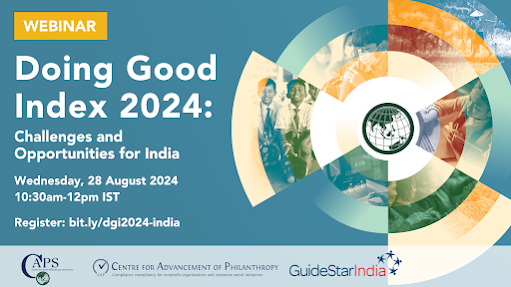
Please join GuideStar India, the Centre for Advancement of Philanthropy (CAP) and the Centre for Philanthropy and Society (CAPS) for a webinar on “Doing Good in India: Challenges and Opportunities” on
Wednesday, August 28 from 10.30-12.00pm IST.
The Doing Good Index 2024 is a biannual report that studies the regulatory and societal environment in which private capital is directed towards doing good in Asia. Now in its fourth iteration, the Index identifies the policies and incentives that can drive private capital to the social sector across 18 Asian economies and considers how stakeholders can build stronger, more trusting connections.
Speakers will highlight India’s performance on the CAPS’ Doing Good Index 2024 and discuss recent challenges and opportunities. A Q&A session will follow.
NGOs in Delhi are invited to celebrate Daanutsav with Delhi Metro
If you’re interested to set up a DaanUtsav Booth at any of the metro stations of Delhi Metro to engage passengers in acts of giving , please sign up here : https://forms.gle/pN94nbN4XNGe5VCJA
If you’re interested to set up collection drives at DMRC Staff Quarters to collect in-kind distribution from the residents.
All allotments are on first come first served basis. Sign up before August 20!
Guidestar India is pleased to share the invitation to the HR workshop on challenges of hiring in the social sector in Delhi, on 23 Aug, being organised by ImpactHire. ImpactHire is a collaborative platform that unlocks, creates and improves livelihood opportunities for professionals in the social sector. Catalysed by collaborative efforts and an AI assisted recommendations, it facilitates discovery of job opportunities, aspirational career paths, valuable certification, training and mentoring and wealth of shared learnings for the dedicated sector workers, motivated crossover professionals and passionate volunteers. It helps HR leaders in improving efficiency , quality of Hiring and HR practices .
Select HR Leaders of SPO, Funding Organisations and Senior leaders are attending the workshop. Two such workshops were conducted in Mumbai and Bangalore where 65 HR leaders participated.
We are happy to announce that NPOs/NGOs continue to make strides in their pursuit of transparency and public accountability.
As of 31st July 2024, an impressive 12,356 NPOs/NGOs voluntarily share their information onGuideStar India. Nearly 200 NPOs/ NGOs participated in GuideStar India’s capacity building workshops on topics such as proactive compliance and how to leverage DaanUtsav, India’s annual festival of giving. This powerful demonstration of commitment is helping to build unparalleled trust and transparency within the social sector.
Congratulations to 45 organisations on successfully completing their GuideStar India certification in the months of May, June and July 2024!
At the forefront of building trust and transparency in the sector are our “Champions of Change” NPO partners:
United Way Bengaluru, Thane Community for the Protection and Care of Animals, Reaching Hand, KHUSHII - Kinship for Humanitarian Social and Holistic Intervention received GuideStar India’s Platinum Seal based on our upgraded certification programme consisting of a comprehensive application review process, capacity building sessions, followed by an assessment rubric of 7 key pillars for exemplary transparency and public accountability.
United Way Bengaluru UWBe, part of United Way Worldwide, is an NGO, focusing on social issues that seek immediate attention. The chapter catalyses unified efforts from government entities, corporates, civic bodies and citizen associations through campaigns such as: ‘Wake the Lake’ which works to protect Bengaluru’s lakes, ‘Born Learning’ helps provide nutrition and education to very young children and ‘Rural Rising’ aims to develop and empower the rural communities. To read about their journey and learn more about how they are making a difference, click here
Thane Community for the Protection and Care of Animals Founded in 2002, Thane Community for the Protection and Care of Animals has dedicated itself to improving the welfare of un-owned, free-roaming animals in Thane, Maharashtra. The organisation provides high-tech veterinary care to all species, including birds and reptiles. This private initiative has served over 1,37,093 animals and birds, with a special emphasis on un-owned animals. Progress is tracked through increased patient numbers and queries, aiming to reach 18,000 animals annually. Founder, Shakuntala Majumdar says “As we commemorate 21 years, of unwavering dedication to animal welfare, our organisation remains committed to the cause of animal welfare, driven by the belief that every living being deserves love, care, and compassion.” To read about their journey and to share their passion for animals, click here
Reaching Hand Reaching Hand, founded in 1996 by the late Mr. V.M. Samuel, is dedicated to bringing positive change to underprivileged communities in Bengaluru. Guided by the founder’s vision to “build, care, serve,” the organisation conducts need assessments to identify and address gaps, focusing on underprivileged children, women, and vulnerable youth. To date, Reaching Hand has served over 105,000 individuals through quality education, healthcare, livelihood, and skill development programs. Key indicators of progress include the number of schools equipped with STEM labs, youth receiving skill training, and children provided with quality education and safe shelter. To read more about their fantastic journey and to be a part of the change they are making, click here 1
KHUSHII - Kinship for Humanitarian Social and Holistic Intervention KHUSHII (Kinship for Humanitarian Social and Holistic Intervention), founded in 2003 by former Indian cricketer Kapil Dev and like-minded individuals, aims to address critical societal needs. Focusing on economically underprivileged children from families with an income less than INR 1500, KHUSHII has served over 93,753 children across Punjab, Haryana, Rajasthan, Madhya Pradesh, Gujarat, Maharashtra, Karnataka, Uttarakhand, Delhi, Uttar Pradesh, Telangana, and Tamil Nadu. The organisation emphasises quality education and skill development, using pre, mid, and post assessments to gauge program impact. KHUSHII remains committed to uplifting underprivileged communities through education and holistic support. To read about their journey and learn more about how they are making a difference, click here
Bhumi Bhumi was founded on August 15, 2006 by a group of friends, who believed that every underprivileged child deserves quality education. Since then, Bhumi has transformed this conviction into a volunteering opportunity for India’s youth, launching a snowball effect of nurturing talent on the path to an educated, poverty-free India. To learn more about the organisation and how they are making a difference, click here
NPOs, whose certification is expiring on or before Dec 31, 2024: your window to apply for renewal is open! Start the process now so that you get the benefit of a full year without and break in your certification status. To apply for your renewal or as a first time applicant, click here 1 to get started.
Presenting our May to July 2024 Honours List:
Status as on July 31, 2024. Please scroll to the right to see the full list.


 Trained 36 outstanding NGOs from diverse thematic areas